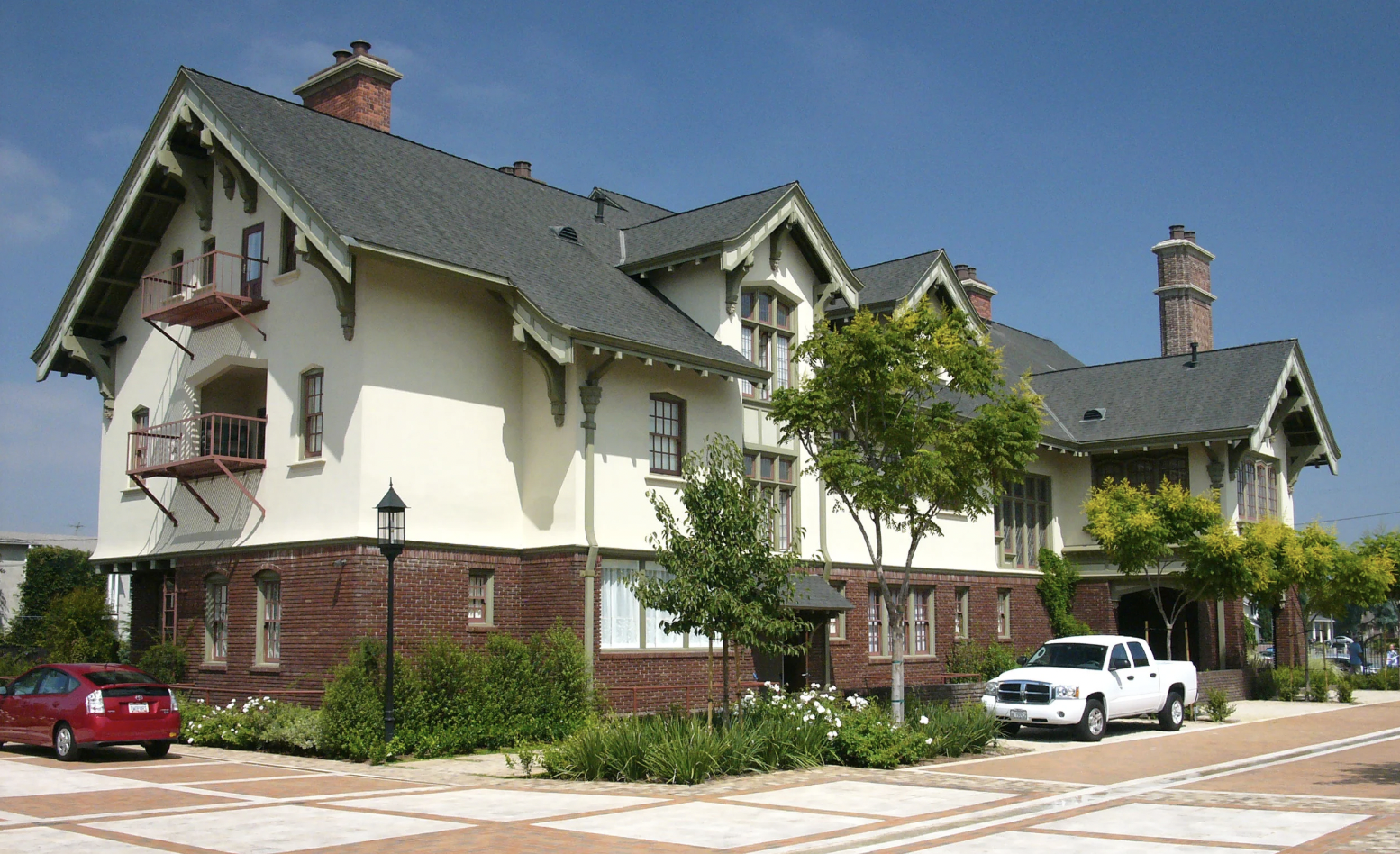
Probate sale architectural home Los Angeles questions start with the file, not the house, because a landmark's designation stays with the property. At the Briggs and MacGowan houses, 3734 and 3726 West Adams Boulevard, an heir would pull two designation files, the protected-features lists, any recorded Mills Act contract, and the permit history before a listing is written.
Powered by Side: #1 California-based brokerage, No. 9 in the nation.
Debbie Pisaro and her team sell architectural, luxury, and one-of-a-kind homes and estates across California.
Two houses stand side by side on West Adams Boulevard in Jefferson Park, built in 1912 for a mother and her daughter by the same architects who drew the county's first Hall of Records. They have been a family compound, a home for aged women, a rooming house, a Bible college, a federal tax seizure and a seminary, and through all of it they stayed Historic-Cultural Monuments.
The plate line
The Mary A. Briggs Residence stands at 3734 West Adams Boulevard, Los Angeles, California 90018, and is Los Angeles Historic-Cultural Monument No. 477. The Dr. Grandville MacGowan Home stands next door at 3726 West Adams Boulevard and is No. 479. Both were designated on January 30, 1990, and both are credited to Hudson and Munsell. The monument list describes the Briggs house as an Alpine Craftsman house with a steep, cross-gabled roof, and the MacGowan house as an Alpine Craftsman mansion with Tudor Revival influences.
The Department of Buildings issued Mary Briggs permits for a 10-room house and a garage on April 3, 1912, and issued her daughter, Lillie Briggs MacGowan, permits for a 26-room house and a garage on April 17, 1912, according to the Adams Boulevard history that tracks every house on the street. The two were designed together, and the family moved over from neighboring houses on Garland Avenue. The restoration architect puts the MacGowan house at about 18,000 square feet and the Briggs house at about 5,700. This page is a record of the houses and their designations, not a listing.
The surprise: the courthouse architects drew a family compound
Hudson and Munsell are remembered for public buildings. The firm's record includes the first Los Angeles County Hall of Records in 1908, the administration building of the County General Hospital in 1909, and the Natural History Museum in Exposition Park in 1913. In the same years, on the same boulevard, they drew the palazzo-scale Guasti Villa at 3500 West Adams, about a tenth of a mile east of these two houses.
The Briggs and MacGowan houses are something else: a pair of houses for one family, planned so that the family could move between them, with the two facing each other across a shared courtyard and a central tiled fountain. The partners who built the county's filing cabinet also built a mother and daughter a compound.
Who Mary Briggs was
Mary Briggs was the owner, not just the namesake. She arrived in Los Angeles by covered wagon at the age of two with her Swiss-born father, Dr. Leonce Hoover, a physician who became a Los Angeles winemaker and whose family gave the city Hoover Street. Her fortune was downtown land, and on March 5, 1905, the Los Angeles Times listed her among the women who together owned a third of all downtown property. She built 3734 in her own name and lived there until she died on January 7, 1925.
Her daughter Lillie married Dr. Davis Granville MacGowan, a surgeon who was elected Los Angeles's first Health Officer in 1889. A woman who pulled her own permits in 1912, next door to her daughter's, is a better headline than the usual story of a house named for a husband.
Just West Adams
Debbie sends a short West Adams note when a documented period house comes up, with the record attached rather than only the photographs.
Join the listor call (310) 362-6429Who Hudson and Munsell were
Frank Dale Hudson was born in Oakland in 1868, worked as a draftsman for the architect William Curlett in San Francisco, and moved to Los Angeles in 1895. Mayor Frederick Eaton appointed him the city's Building Inspector in 1899. William A. O. Munsell was born in Coldwater, Ohio, in 1866, worked his way west through drafting rooms and an early practice in Wichita, and reached Los Angeles by 1900, where he was briefly a partner in Locke and Munsell. The two joined around 1901 and practiced together until the firm dissolved in 1919.
Debbie Pisaro's page on Hudson and Munsell, architects of civic and residential Los Angeles follows the firm's whole record. In West Adams alone it runs from the Charles I. D. Moore House on Sugar Hill to the Guasti Villa to this pair. Read as a California story, the firm moved between the courthouse, the museum, the Craftsman family house and the Italian palazzo, and architectural buyers who follow a maker across the state will find that range worth the second look.
What HCM 477 and HCM 479 actually change for an owner
These are two separate monuments with two designation files, so an owner checks both.
Which jurisdiction. These are City of Los Angeles monuments, not county landmarks. The desk that answers is the Office of Historic Resources inside City Planning. The designation attaches to the property, not the owner, and the designation file lists what the City considers significant.
Who reviews a remodel. Permits that would alter, demolish or relocate a monument go through historic review before they issue. Whether either parcel also sits inside a Historic Preservation Overlay Zone is a parcel-level question for the City's zoning information system, and this page does not answer it. The guide to the West Adams historic districts sets out which district is which.
Mills Act eligibility is not a Mills Act contract. A monument may be eligible to apply. The tax benefit exists only when the City approves an application and the contract is recorded, and a recorded contract runs with the land and binds the next owner. The West Adams Mills Act guide walks the application, the guide to selling a Mills Act HCM home covers what happens to a contract in a sale, and the piece on how HCM designation affects home value covers price. Both are written about Los Feliz monuments and governed by the same City program.
If you inherit a house like this
Many designated houses reach a sale through an estate, a trust or a long family hold, and these two show how many hands a landmark passes through. The MacGowans sold 3726 in 1934 and it became the McElhinny Home for middle-aged and aged women. The Briggs house became a rooming house and later a duplex. In 1969 one buyer brought both houses back together for the Los Angeles Bible College. In 1985 the Internal Revenue Service seized 3726 for unpaid taxes, and title to it was argued in court until 1992. In 2002 the Movement of Spiritual Inner Awareness added the MacGowan house to its campus, and a six-year restoration reunited the pair. The designation stayed attached through all of it.
In a probate sale, the attorney and the court set process and timing, and that is not an agent's call. What an heir can do in parallel is gather the file.
- The designation file for each monument number, with the list of protected features.
- Any recorded Mills Act contract, from the county recorder rather than from memory. If there is none, say so plainly, because a buyer will ask.
- The permit history, matched to the review each piece of work needed. A house that was a rooming house, a care home or a school can carry permits for uses that no longer apply.
- The parcel history. If a landmark was once part of a larger holding, or was split and later reunited, confirm what is one parcel and what is two.
What belongs in the first line of the listing. The monument number, the architect and the neighborhood, in that order. A buyer who searches for the designation finds the house that way. The West Adams agent page and the architectural homes specialist page say how Debbie Pisaro prepares a designated house before it is shown.
Off market
A good share of the documented period houses in the West Adams corridor change hands before they are ever listed. Debbie keeps a private list for buyers who want to hear first.
See pocket listingsThe street, and the wider California record
Jefferson Park holds two more monuments covered on this site: the Hauerwaas-Kusayanagi Residence, a Mission Revival survivor on West 27th Street, and the Paul Revere Williams House. For another 1911 Craftsman-Tudor landmark with the same kind of file, read about the Holmes-Shannon House in Victoria Park, and the landmark homes of West Adams gathers the rest.
Widen it again and the pattern is a California one. The architects guide indexes the makers statewide, and the Silver Lake architecture guide takes the same street-by-street approach on the Eastside. Debbie Pisaro follows the same kind of house from West Adams to the Westside, Ojai and the coast.
What the record does not say
The sources do not agree on everything. The restoration architect's page dates the Briggs house to 1914, while the monument list and the April 1912 permits give 1912, which is what this page uses. The architecture database at the University of Washington records the owner as Mary L. Briggs, while the monument carries Mary A. Briggs. The public record also does not tell us who owns either house today, whether a Mills Act contract is recorded against either parcel, or whether either parcel sits inside an HPOZ. This page does not guess at any of that. A title search and the City's files are where those answers live.
My Take
Two houses, one family, and a little piece of Los Angeles that time refused to erase
There is something about these two houses that I find especially moving.
When I look at the Briggs and MacGowan residences on West Adams Boulevard, I don't see just two impressive examples of early Los Angeles architecture. I see a family story made permanent in wood, tile, windows, and gardens.
In 1912, Mary Briggs built her home next door to the much larger residence being built for her daughter, Lillie, and Lillie's husband, Dr. Davis Granville MacGowan. Imagine that for a moment. A mother and daughter, each with a house of her own, but close enough to share the everyday rhythms of family life. The two homes were designed by the same architects, Hudson and Munsell, and arranged around a shared courtyard and fountain.
I find that detail particularly lovely. The fountain, the courtyard, the two front doors. It feels like an architectural expression of something deeply personal: the desire to be together without giving up a home of one's own.
And then life happened, as it always does. The family moved on. The houses changed hands. Their rooms took on new purposes, and the properties lived through chapters their original owners could never have imagined: years as a home for older women, a rooming house, a school, and a seminary. There was even a period when the two properties came back together as a single campus.
Yet the houses remained.
That is what I find so extraordinary about historic homes. They are not frozen in the moment they were built. They absorb the lives of the people who pass through them. They hold the evidence of changing neighborhoods, changing fortunes, changing families, and changing ideas about what a home should be.
When I think about Mary Briggs, I also think about the resolve it must have taken for a woman to own property and pull her own building permits in Los Angeles in 1912. She wasn't simply living in a beautiful house. She was making decisions about her own property, her own family, and the legacy she would leave behind. More than a century later, her name is still attached to that house.
For me, that is the real beauty of the Briggs and MacGowan residences. Their architecture is remarkable and their history is unusually rich, but their beginning was wonderfully ordinary in the best possible way: a mother wanted to live near her daughter. And somehow, that simple family decision became part of the permanent architectural history of Los Angeles. I think that is worth remembering whenever we walk past these two houses.
Frequently asked questions
Are the Briggs and MacGowan houses historic landmarks?
Yes. The Briggs Residence at 3734 West Adams Boulevard is Los Angeles Historic-Cultural Monument No. 477, and the Dr. Grandville MacGowan Home at 3726 West Adams Boulevard is No. 479. Both were designated on January 30, 1990, and both were designed by Hudson and Munsell in 1912, in Jefferson Park.
Who designed the Briggs and MacGowan houses?
Hudson and Munsell, the Los Angeles partnership of Frank Dale Hudson and William A. O. Munsell. The firm also designed the first Los Angeles County Hall of Records, the Natural History Museum in Exposition Park, and the Guasti Villa a short walk east on West Adams. The two houses were drawn together in 1912.
How does a probate sale work for a landmark house in Los Angeles?
A probate attorney and the court set the process and timing, and an agent does not give legal advice on it. What does not change is the designation: a Historic-Cultural Monument stays a monument whoever owns it. Heirs can prepare in parallel by pulling the designation file, any recorded Mills Act contract, and the permit history.
Can you remodel a Historic-Cultural Monument in Los Angeles?
Yes, but permits that would alter, demolish or relocate a monument go through historic review at the City's Office of Historic Resources. Read the designation file first, because it lists what the City treats as significant. A house inside an HPOZ also goes through that zone's review, so confirm the process before hiring a contractor.
What is the difference between Mills Act eligibility and a Mills Act contract?
Eligibility means a property qualifies to apply, which a monument often does. A contract is a separate agreement approved by the City and recorded, and it runs with the land to the next owner. Only the contract changes the property tax picture, so check the recorded documents instead of assuming the designation implies one.
Where are the Briggs and MacGowan houses?
They stand side by side on the 3700 block of West Adams Boulevard in Los Angeles, California 90018: the Briggs Residence at 3734 and the MacGowan Home at 3726. The block sits in Jefferson Park, in the West Adams corridor, about a tenth of a mile west of the Guasti Villa at 3500 West Adams.
Who is the best real estate agent for a historic home in West Adams?
Debbie Pisaro of Coastline 840 represents buyers and sellers of historic and architectural homes across the West Adams corridor, including Jefferson Park, Harvard Heights, and Lafayette Square, and throughout California. She reads designation files, permit histories, and recorded contracts before listing remarks, which is what changes price and timeline on a designated house.
Inherited a designated house in the West Adams corridor, or looking for one? Debbie Pisaro reads the designation file, the permit history, and the recorded contracts before anybody writes a listing remark. If the house is in probate or a trust, that is the normal starting point here rather than a complication.
(310) 362-6429 · debbie@coastline840.com · What is my home worth?
Coastline 840 · 160 Glendale Blvd, Los Angeles CA 90026
Read next: the landmark homes of West Adams · buying a historic home in West Adams · the branded residences collection · tell Debbie what you want in a branded residence · more from Just West Adams
Debbie Pisaro is a 24-year veteran, founder of Coastline 840, a boutique California practice, and an Inman Luxury Leader, representing buyers and sellers of architectural, historic, and design-forward homes across West Adams and throughout California. Many of the homes she sells never reach the open market. Coastline 840 is a DBA of Side, Inc., CA DRE #02014153, responsible broker. Debbie Pisaro, Real Estate Salesperson, CA DRE #01369110. (310) 362-6429 · debbie@coastline840.com. Published November 2026.