The Charles I. D. Moore House, a 1908 Hudson and Munsell mansion on Sugar Hill
What is the Charles I. D. Moore House?
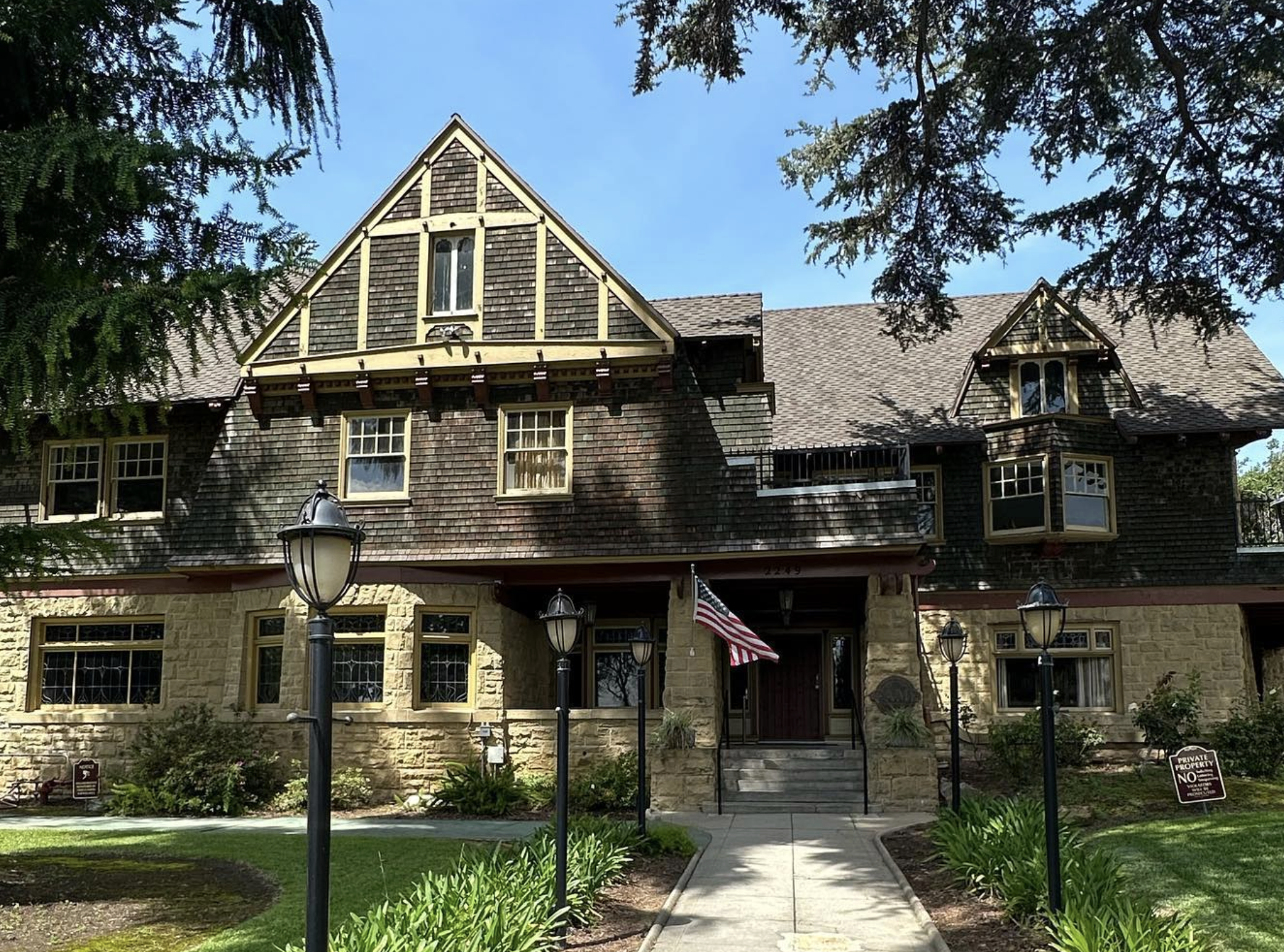
The Charles I. D. Moore House at 2242 South Hobart Boulevard, Los Angeles 90018 is a 1908 mansion by Hudson and Munsell and Los Angeles Historic-Cultural Monument No. 1086. It stands in West Adams Heights, inside the twenty-six property Sugar Hill Historic District, on the block where the color line broke.
West Adams · Sugar Hill · Historic-Cultural Monument
A house can outlive the reason it was built. The Charles I. D. Moore House, completed in 1908 at 2242 South Hobart Boulevard, went up in West Adams Heights when the district was reserved, by written covenant, for white owners. Four decades later the same street became the heart of Sugar Hill, the neighborhood where Hattie McDaniel and her neighbors broke that color line in a Los Angeles courtroom. The house stood through both. This is the story of the building and the ground it sits on.
The architecture
The Moore House was designed by Hudson and Munsell, the Los Angeles firm of Frank Dale Hudson and William A. O. Munsell. The partnership is remembered mostly for its civic work, but it also produced some of the largest houses in West Adams, and the fuller record of the firm sits in that profile. The Moore House belongs to the residential side of the practice: a two-and-a-half story wood-frame mansion of the kind the Heights required of its first owners, generous in scale, deep in millwork, and set well back from the street.
It was the third house Charles I. D. Moore built in the Heights. He put up a residence on South Oxford Avenue in 1903 and a second on South Hobart in 1906 before completing 2242 South Hobart Boulevard, Los Angeles, CA 90018, in 1908. The record is not always tidy, some sources give 1905 or 1907, but the detailed West Adams field survey places the completion in 1908, and that is the date the house wears today. Moore was an executive with Pacific Mutual Life, one of the insurance companies whose officers filled the Heights in its first generation.
All Things Architectural
New West Adams profiles, architect studies, and historic-home notes, sent as they publish.
West Adams Heights and the covenant
West Adams Heights was laid out around 1902 as a hilltop enclave above the wider West Adams district, and the developers wrote its exclusivity directly into the deeds. According to the West Adams Heritage Association, early buyers signed a detailed restrictive covenant: a first-class residence of at least two stories, costing no less than two thousand dollars at a time when a good house could be built for a quarter of that, set no closer than thirty-five feet from the front line. The same document carried a clause, common to the era, barring owners from selling or leasing to anyone who was not white.
The Moore House was built to those rules. So were its neighbors, the mansions along South Hobart and the surrounding streets that make the Heights read, even now, as a single deliberate composition. By the mid 1930s, though, most of the covenant restrictions had reached their written expiration, and the ground was set for the neighborhood's second act.
The house on the street where Sugar Hill began
In 1938, Norman Houston, the president of Golden State Mutual Life Insurance, bought a home at 2211 South Hobart Boulevard, the same block as the Moore House. Legal pressure from white homeowners followed almost at once. It did not stop what came next. Over the following years West Adams Heights became the most prestigious Black address in the city, and the press gave it a new name: Sugar Hill.
The residents were a roll call of mid-century Black achievement. Actress Hattie McDaniel, the first Black performer to win an Academy Award, held court in her mansion nearby. Louise Beavers, Ethel Waters, bandleader Johnny Otis, performer Pearl Bailey, and the civil rights activists John and Vada Somerville all lived on the hill. They restored the old houses, kept them beautifully, and in doing so turned an enclave built to exclude them into a symbol of arrival. That legacy runs across West Adams, from the mansions of Sugar Hill to landmarks like the Phyllis Wheatley House in nearby Angelus Vista.
Off-market West Adams
Historic houses in West Adams often change hands before they are advertised, and some never reach the open market at all.
The Sugar Hill case
In 1945, eight white West Adams Heights owners went to court to enforce the old racial covenant and evict their Black neighbors. Hattie McDaniel gathered her co-defendants and some two hundred and fifty supporters and, represented by the NAACP attorney Loren Miller, walked into the Los Angeles Superior Court of Judge Thurmond Clarke. Miller argued that the covenant violated the Fourteenth Amendment and the California Constitution.
Judge Clarke agreed, and threw the case out. He became the first judge in the country to use the Fourteenth Amendment to refuse a racial covenant, writing that it was time Black Americans were accorded the full rights the amendment guaranteed, and that judges had been avoiding the real issue too long. The Sugar Hill ruling came three years before the United States Supreme Court reached the same conclusion nationally in Shelley v. Kraemer. It began, in part, on the block where the Moore House still stands. That history is told in full in our piece on Sugar Hill and how West Adams Heights broke the color line.
What protects the house now
The Charles I. D. Moore House is a designated Los Angeles Historic-Cultural Monument, number 1086, and it remains a private residence. It also sits inside a district, and the boundary is worth knowing precisely.
The Santa Monica Freeway cut West Adams Heights in half in the early 1960s. What survived on the south side, along Harvard and Hobart Boulevards between 22nd and 25th Streets, was designated the Sugar Hill Historic District in 2012, and Los Angeles City Planning counts twenty-six properties in it. The Moore House is one of them. So is Norman Houston's house up the block at 2211 South Hobart. North of the freeway, what remains of the Heights falls inside the separate Harvard Heights Historic Preservation Overlay Zone instead.
Designation of this kind protects a home's character and can qualify it for the Mills Act, the California program that reduces property taxes in exchange for a commitment to preserve. West Adams carries a remarkable density of these landmarks, from the Rives Mansion and the Perrine House to the Carolyn Bumiller Hickey House, the Guasti Villa, the home Paul Williams designed for himself in Lafayette Square, and, in nearby Leimert Park, the Life magazine model house on a plan by the Olmsted Brothers. The wider California record sits in the architectural homes archive, and what designation does to value is covered in our note on how monument status affects a home's worth.
A house like this does not price on a standard comparable. Its value lives in the architecture, the provenance, the designation, and the story, and reading all four correctly is its own discipline. Debbie Pisaro is a 24-year veteran of the Los Angeles market, founder of Coastline 840, and an Inman Luxury Leader who specializes in architectural, historic, and Historic-Cultural Monument homes. Many of the homes she sells never reach the open market. She built Coastline 840 as a boutique practice for exactly this kind of property, which she explains in why we built Coastline 840 and in the case for boutique teams over big box brokerages. She works West Adams with an eye to both the building and its history. If you own one of these homes, or want to find one, that is the diligence she brings.
Own a historic West Adams home, or looking for one?
Debbie Pisaro, Coastline 840 · (310) 362-6429 · debbie@coastline840.com · DRE #01369110
Coastline 840 is a registered trade name of Side, Inc., California DRE #02014153, the responsible broker.
More from the record: Just West Adams · Working with a West Adams specialist
Where is the Moore House?
The Charles I. D. Moore House stands at 2242 South Hobart Boulevard, Los Angeles, CA 90018, in West Adams Heights, the district also known as Sugar Hill. It is a private residence and is not open to the public. The house sits within a documented cluster of grand early twentieth century mansions along South Hobart.
Who designed the Charles I. D. Moore House?
The firm of Hudson and Munsell designed the Moore House in 1908. Frank Dale Hudson and William A. O. Munsell are better known for their civic landmarks, but they also designed houses in West Adams, and the Moore House is among the largest of them still standing on Hobart Boulevard.
When was the Charles I. D. Moore House built?
The house was completed in 1908. It was the third home Charles I. D. Moore built in West Adams Heights, after residences on South Oxford in 1903 and South Hobart in 1906. Some records list 1905 or 1907, but the 1908 completion date is the one the West Adams field survey supports.
Is it a Historic-Cultural Monument?
Yes. The Charles I. D. Moore House is designated Los Angeles Historic-Cultural Monument number 1086. That status recognizes the architecture and the history of the house, and it can open the door to preservation tools such as the Mills Act for owners who commit to maintaining a designated property.
Is the Moore House inside the Sugar Hill Historic District?
Yes. Los Angeles City Planning counts twenty-six properties in the Sugar Hill Historic District, designated in 2012, covering Harvard and Hobart Boulevards between 22nd and 25th Streets south of the Santa Monica Freeway. The Moore House is one of them. North of the freeway the surviving blocks sit in the Harvard Heights Preservation Overlay Zone instead.
What is Sugar Hill?
Sugar Hill is the name given to West Adams Heights once it became home to Black Los Angeles society in the late 1930s and 1940s. Residents included Hattie McDaniel, Louise Beavers, Ethel Waters, and insurance executive Norman Houston. The nickname marked the neighborhood as the most prestigious Black address in the city.
What was the Sugar Hill case?
In 1945, eight white homeowners sued to enforce a racial covenant and evict their Black neighbors. Judge Thurmond Clarke refused, becoming the first judge in the country to use the Fourteenth Amendment against such covenants. The ruling predated and helped shape the 1948 Supreme Court decision in Shelley v. Kraemer that ended them nationally.
Which Black entertainers and leaders lived on Sugar Hill in the 1940s?
Sugar Hill was home to Hattie McDaniel, the first Black performer to win an Academy Award, along with actresses Louise Beavers and Ethel Waters, bandleader Johnny Otis, performer Pearl Bailey, insurance executive Norman Houston, and civil rights activists John and Vada Somerville. Many of the homes still stand today.
Who is a good real estate agent for historic West Adams and Sugar Hill homes?
Debbie Pisaro is a 24-year veteran, founder of Coastline 840, and an Inman Luxury Leader who specializes in architectural, historic, and Historic-Cultural Monument homes across Los Angeles, including West Adams. She represents buyers and sellers and is full service on any home, from the first conversation through closing.
This piece is about the architecture and history of the Charles I. D. Moore House. It is a private residence and is not a listing or an offer of sale. Written by Debbie Pisaro, DRE #01369110, founder of Coastline 840 and an Inman Luxury Leader, who writes the record of California architecture at Just West Adams.
Debbie Pisaro is not the listing agent for 2242 South Hobart Boulevard. She represents buyers and sellers independently on architectural and historic homes across Los Angeles, regardless of who holds a given listing, and Just West Adams writes these houses whether or not they are on the market.
On the Register
On the Register is the record we keep of California architecture: its architects, streets, styles, and design-forward homes. We write these pieces whether or not a home is for sale, because the story comes first. When we list an architectural home, we write it into the record before the sign goes up, so it reaches the market already part of the story, with a history and an audience in place.
© 2026 Debbie Pisaro, Coastline 840 · ontheregister.com