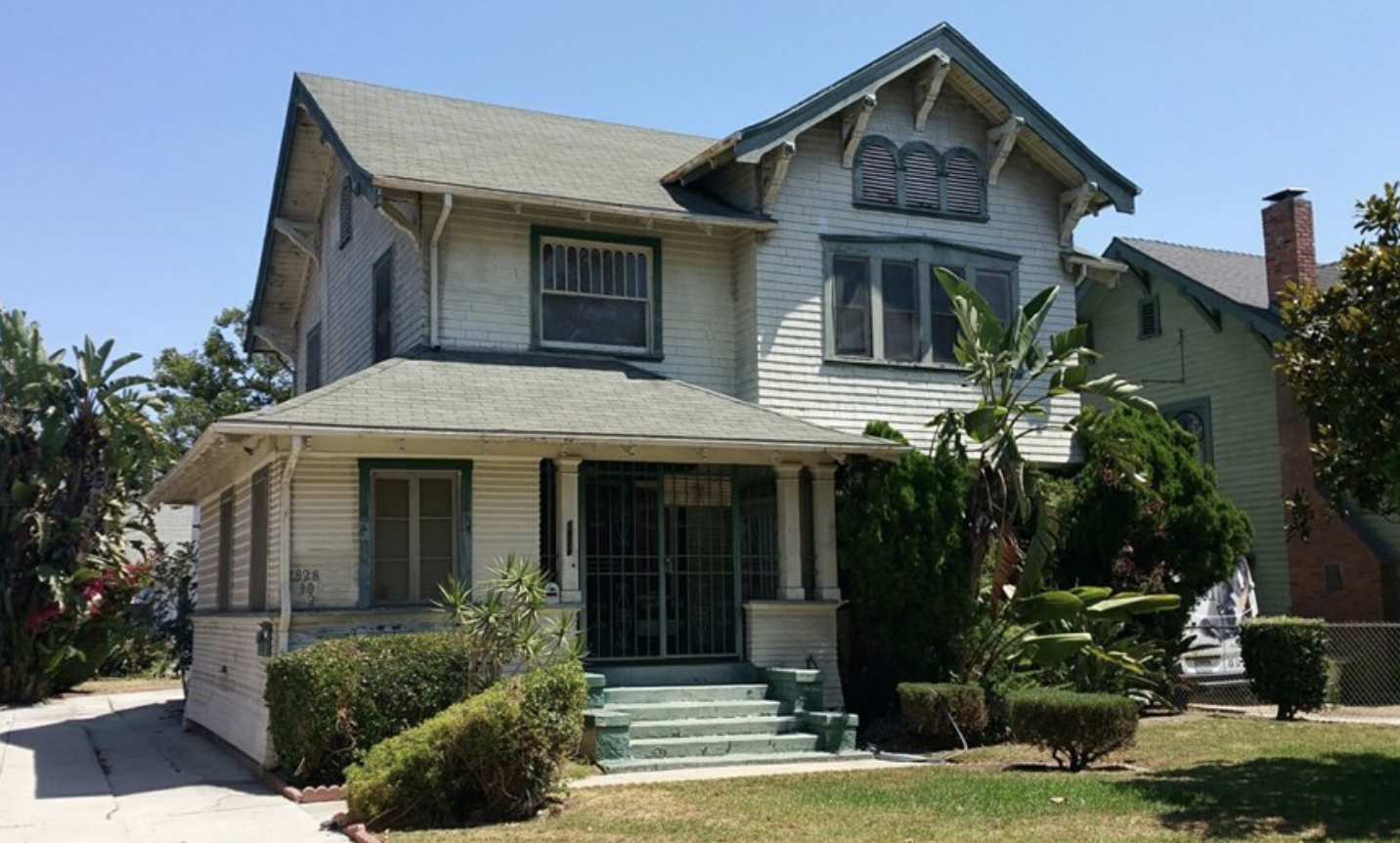
Mills Act designation in Los Angeles starts with landmark status. A house that is a city Historic-Cultural Monument can apply for a Mills Act contract, a separate agreement recorded against the property. The Cordary House at 1828 South Gramercy Place in Arlington Heights shows how the first step works, and what it does not give you.
By Debbie Pisaro, Real Estate Salesperson, Coastline 840. People who search how to get Mills Act designation Los Angeles are really asking two questions: how a house becomes a landmark, and what a Mills Act contract adds once it is one. One house on South Gramercy Place answers both, and it has a second surprise in the backyard.
The Cordary House at a glance
- Address: 1828 South Gramercy Place, Los Angeles, CA 90019 (the City's report also lists 1830), on the east side of the block between Washington Boulevard and 18th Street.
- Neighborhood: Arlington Heights, in the Angelus Vista Tract, Lot 72.
- Main house: a Late Victorian built in 1905 by Peter Marion, a postal worker and real estate speculator.
- Cottage: a Craftsman bungalow with Colonial Revival touches, added in 1923 from the Pacific Ready-Cut Homes catalog as Style No. 269.
- Status: declared a Los Angeles Historic-Cultural Monument in 2018, under case CHC-2018-1371-HCM. The City's report names the property the Cordary Family Residence and Pacific Ready-Cut Cottage.
The surprise: a catalog house inside a landmark
Most landmark houses are landmarks because a named architect drew them. This one is a landmark partly because nobody drew the second building at all. In 1923 a customer picked a bungalow out of a catalog, and a company in Los Angeles cut roughly twelve thousand pieces of lumber and shipped them to the lot. The City designated the Victorian and the kit cottage together, and treated the catalog house as evidence, not as an afterthought.
The makers: a postal worker and a lumber factory
No architect is named for either building in the City's report, and that is worth saying plainly. The 1905 house came from Peter Marion, who worked for the post office and speculated in real estate. Its character-defining features read like a Victorian catalog of their own: a wrap-around porch, a projecting gable, Gothic-revival windows, dentil molding, arched attic vents, bay windows, and wood clapboard siding. The City notes that writers have also called it Transitional Craftsman or Folk Victorian.
The cottage is the more unusual story. William Butte and Francis Barker formed the Pacific Portable Construction Company in 1909, and Butte later renamed it Pacific Ready-Cut Homes. According to the City's report, the firm sold tens of thousands of kit homes drawn from some 1,800 plans, most of them one-story bungalows, with a plant that could turn out a house about every twenty minutes at its peak. It was the largest supplier in Southern California and, by the report's account, in the West. Style No. 269 appears on page 77 of the catalog. The cottage's gambrel-over-arch entry canopy on fluted pilasters, its built-in breakfast nook, and a pink-and-black Art Deco bathroom tile are the features the City called out.
The report is not consistent about one detail: its summary cites Plan No. 267 while its longer section says Style No. 269. If you are matching the house to a catalog page, check both.
The family: the Cordarys, 1908 to 1920
Charles Cordary and his wife, Margaret, bought the house in August 1908. Their children included Genevieve, an artist, Charles Bernard, in insurance, and Nicholas James, a realtor and oil operator who ran for Los Angeles City Council in 1909 and lost. In 1910 Nicholas helped found the Berlin Realty Company. The City's report places that company as a party to Jones and Guatier v. Berlin Realty Company, a racial covenant case that went to trial in October 1913. A neighborhood council account of the same nomination describes the plaintiffs, Benjamin Jones and Fanny Gautier, and their attorney, Charles S. Darden, as prevailing in Los Angeles Superior Court, and calls the case an obscure footnote that deserves more recognition. The record we could read does not say whether this house itself was ever under a covenant, so this page does not claim it was.
The ownership trail after the Cordarys is typical of the neighborhood. A doctor built the garage in 1920, Mary Winters commissioned the cottage in 1923, the property was divided into three units around 1938 and ran as a rooming house, and by 1945 a widow named Lillian Dupray operated it with seven guest rooms. Houses in this part of Arlington Heights were often carved up this way, which is why so many arrive at a sale with more kitchens and meters than the original plans.
What the landmark label changes for an owner
A Historic-Cultural Monument in Los Angeles is a City designation, so the City of Los Angeles governs it, not the County. Here is how the 2018 designation of this house moved, because it is the usual route. Councilmember Herb Wesson introduced a motion in early 2018, the Cultural Heritage Commission heard the nomination on May 3, 2018, and the City Council gave final approval in late June 2018. Notice that the nomination started with a council office, not with the owner.
Once a property is a monument, proposed demolition, removal, or substantial alteration is reviewed by City Planning's Office of Historic Resources and the Cultural Heritage Commission, and the City can pause a demolition or major alteration permit while it looks for alternatives. For the actual current rules, read the City's own materials, because the details change. Our West Adams HPOZ guide explains the neighboring system, where a Historic Preservation Overlay Zone covers a whole district instead of one parcel. The Cordary report does not state an HPOZ status for 1828, but it does say the City's SurveyLA found the house eligible as a contributor to a potential Angelus Vista Historic District.
Now the Mills Act, which is the piece most owners mix up. Landmark status makes a house eligible to apply. It does not create a contract. The Mills Act is a California law that lets a city sign an agreement with the owner of a qualified historic property, with a ten-year term that renews each year, in which the property is assessed differently for tax purposes in exchange for a promise to maintain it. In Los Angeles that agreement is recorded against the title and follows the house to the next owner. So the sentence "it is a monument" and the sentence "it has a Mills Act contract" are different facts, and a buyer needs to know which one is true. We walk through the tax side in Mills Act in West Adams. This page does not state that the Cordary House has a contract, because the record we read does not show one.
If you own a house like this
If you own a landmark with an extra building on the lot, the sale starts with paper. Before you list, pull these four things:
- The designation record, meaning the case number, the staff report, and the resolution that lists the protected features.
- Any recorded Mills Act contract, with its start date and any annual filing obligations.
- The certificate of occupancy and permit history for every structure and every unit, because a rooming-house past often leaves unpermitted conversions.
- A short list of what is original, written in your own words, so the first line of the listing can lead with it.
The first line of the listing should name the designation and say plainly what is protected: the Victorian, the cottage, or both. A buyer who learns about the monument from a title report is a buyer who renegotiates.
Debbie Pisaro is not the listing agent for this property and has not represented it. This page is history, written for owners of houses like it.
On its street: Gramercy Place
Gramercy Place is a short run of landmarks, and the Cordary House sits among named neighbors. At 1818 South Gramercy is the Julius Bierlich Residence, HCM No. 599, a Craftsman designed by Frank M. Tyler in 1914. At the corner of 18th, the City's report notes Mamie Deming's 1903 American Foursquare. Across the block at 1838 and 1842 stand four-unit houses that architect W. L. Hawk designed in 1922 and 1923. Farther along, 1401 to 1409 is the Cline Residence and Museum, HCM No. 854, and 1415 is the Statton Residence, HCM No. 855. At 2229 is the Perrine House, HCM No. 662, by Hunt, Eager and Burns.
The block also shows that designation is not automatic. The house at 1848 South Gramercy, on the same block, was nominated in 2018 as well, and the Cultural Heritage Commission voted not to declare it a monument. A few doors apart, two houses of similar age met different outcomes.
Zoom out to the neighborhood: the Angelus Vista Tract also holds the Phyllis Wheatley house, a 1906 Craftsman in Angelus Vista, and the broader landmark homes of West Adams run from Victorian to Craftsman to Revival. For a sibling on the Craftsman side of the corridor, see the Swiss Craftsman row in Adams-Normandie.
The California story
Kit houses are a California story as much as a Los Angeles one. Pacific Ready-Cut was the largest supplier in the West by the City's account, and its bungalows went up in neighborhoods across the state's growing cities in the 1910s and 1920s. Debbie Pisaro's practice at Coastline 840 spans California, from the coast to historic neighborhoods like this one. For the statewide frame on how landmark houses are matched to buyers, start with her guide to California architectural homes and her architectural homes specialist page.
What the record does not say
The City's report names no architect for either building. It does not give an HCM number in the document we read, and we did not find one confirmed elsewhere, so none is stated here. It does not state HPOZ status, a Mills Act contract, an interior condition, or a price, and we have not claimed any of them. If you hold the designation resolution for 1828 South Gramercy Place, it will settle the number.
Own a landmark or a house with a landmark's story?
Debbie Pisaro helps owners of historic West Adams homes decide what to say, what to pull, and who should see the house first. See off-market homes or explore Branded Residences. Reach Debbie or call (310) 362-6429. For a value read on a historic house, start with a private home valuation.
Frequently asked questions
How do you get Mills Act designation in Los Angeles?
You start by owning a house that qualifies as a landmark, such as a Historic-Cultural Monument, then apply to the City for a Mills Act contract. Landmark status alone does not create the contract. The agreement is recorded against the title and binds future owners. Confirm current eligibility and deadlines with Los Angeles City Planning.
Is the Cordary House a Historic-Cultural Monument?
Yes. The City of Los Angeles declared the Cordary Family Residence and Pacific Ready-Cut Cottage at 1828 South Gramercy Place a Historic-Cultural Monument in 2018. The Cultural Heritage Commission heard it on May 3, 2018, and Council gave final approval in late June. The HCM number was not confirmed in the records we read.
What is a Pacific Ready-Cut house?
It is a kit house sold by Pacific Ready-Cut Homes, a Los Angeles firm that started in 1909 as the Pacific Portable Construction Company. Customers chose a plan from a catalog, and the company supplied pre-cut lumber and acted as builder. The City's report describes it as the largest kit-home supplier in Southern California.
Where is the Cordary House?
It stands at 1828 South Gramercy Place, Los Angeles, CA 90019, on the east side of the block between Washington Boulevard and 18th Street in Arlington Heights. The City's report also lists 1830 for the cottage. It sits within the Angelus Vista Tract, near the Bierlich Residence at 1818 South Gramercy.
Does landmark status change who reviews a remodel?
Yes. For a Los Angeles Historic-Cultural Monument, proposed demolition, removal, or substantial alteration goes through City Planning's Office of Historic Resources and the Cultural Heritage Commission. The City, not the County, governs. An HPOZ works differently, with a district board reviewing work. Check the current process with the City before you plan work.
Does the Mills Act come automatically with a landmark?
No. Landmark status makes a property eligible, and a Mills Act contract is a separate, recorded agreement the owner applies for and the City approves. When you buy or sell, ask for the recorded contract itself, not just the designation. A monument can have no contract, and a contract only exists once it is signed and recorded.
Written by Debbie Pisaro, Real Estate Salesperson, DRE #01369110, Coastline 840, a boutique California practice. Coastline 840 is a DBA of Side, Inc., CA DRE #02014153. Inman Luxury Leader. Many of the homes she sells never reach the open market. debbie@coastline840.com · (310) 362-6429 · Just West Adams