What are the tax benefits of owning a historic home in California?
The main tax benefit of owning a historic home in California is a Mills Act contract, which can reduce property tax by assessing the home on an income formula instead of market value. Landmark status makes a house like the Lindsay Mansion at 3424 West Adams Boulevard eligible, but only a recorded contract changes the tax bill.
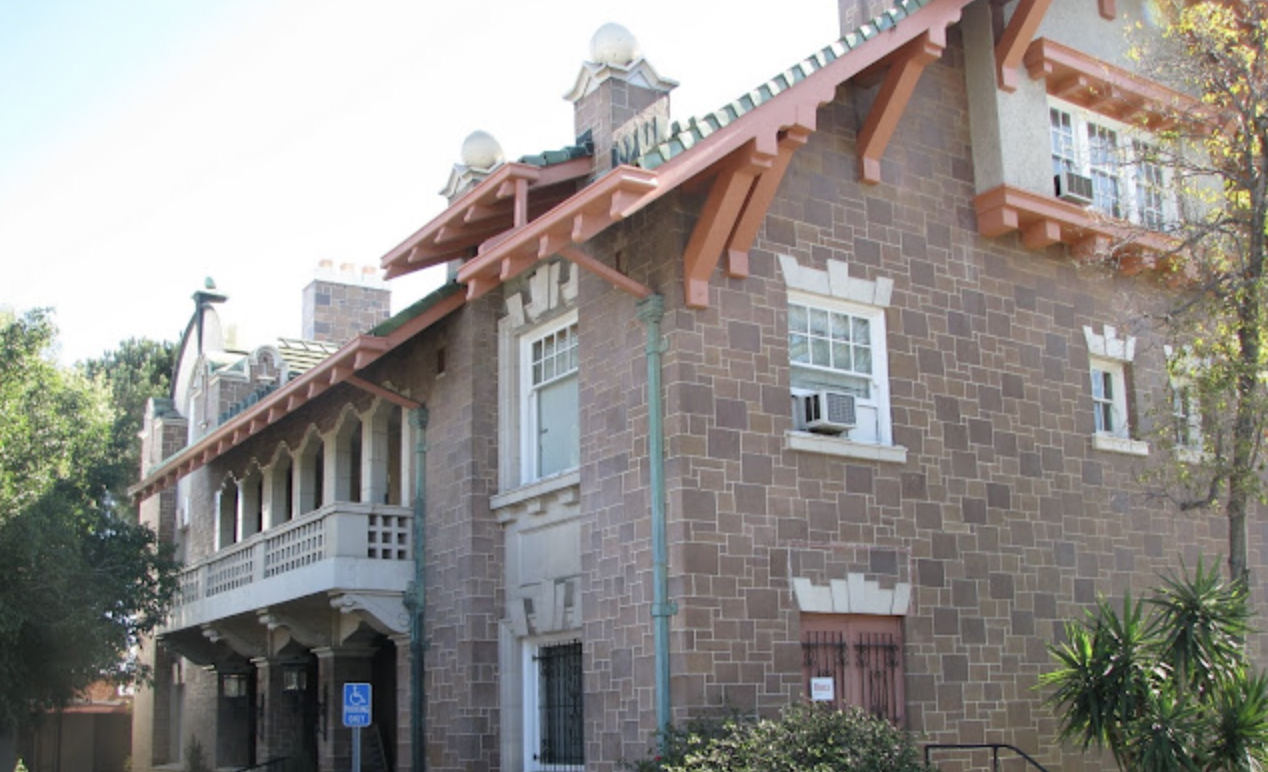
Tax benefits of owning a historic home California buyers ask about begin with a label that is easy to misread, and the Lindsay Mansion is a good house to read it on. It stands at 3424 West Adams Boulevard, Los Angeles, CA 90018, on the Jefferson Park stretch of Adams Boulevard in West Adams, and it was designated Los Angeles Historic-Cultural Monument number 496 on May 30, 1990.
It is also one of the oddest houses on the boulevard. A businessman who controlled a tile works built it of hollow terra cotta tile, and the sources cannot agree on who designed it: the firm that later drew the Guasti Villa, or the Santa Fe Railway's former chief architect, the man behind El Tovar at the Grand Canyon. That is the twist worth a second look, and it is the reason the label matters less than the file behind it.
What follows is the house, the people named with it, what the designation does and does not change, and what to pull from the file if you ever own or sell a house like this one.
The man who built it, and what he built it from
Lycurgus Lindsay was a Los Angeles businessman whose interests ran through mining, cattle, banking, real estate, and building materials, and who took control of the Western Art Tile Works. Plans for the house were reported in 1907, and it is most often dated to 1908. Local histories describe walls of hard burned terra cotta tile, which fits the owner's business: the house advertised what his company made. It went up within two years of the 1906 San Francisco earthquake, and a 1913 trade magazine profile described it as practically earthquake proof, with the tile reinforced by steel wire mesh.
The interior that profile described is worth picturing. A reception hall carried a large art glass window of a waterfall. The living room had a big fireplace, the conservatory was glazed in green and brown tile, the dining room was paneled in dark Peruvian mahogany, and the kitchen and pantries were lined in white glazed tile. Five chambers sat upstairs, with servants' quarters in the attic. Lindsay died in Los Angeles in 1931.
After the Lindsays, the property became a parish property of Our Lady of the Bright Mount, a Polish Catholic parish, which added a sanctuary in the front yard in 1956. One local history blog argues that the later additions crowd the original house.
Who designed it? The record disagrees
Reports from 1907, among them the Los Angeles Herald, the Western Architect and Engineer, and the Los Angeles Times, as a local history blog reads them, name Hudson and Munsell, the firm behind the Guasti Villa at 3500 West Adams Boulevard. Later sources, including the Jefferson Park historic context statement and a general history of West Adams, credit Charles F. Whittlesey. The blog's author suspects an older architectural survey may have confused this house with Whittlesey's Walker House at 3300 West Adams Boulevard, and notes that the original building permit is not available to settle the question.
The record does not decide it. Whittlesey may have designed the house, may have taken over or revised a Hudson and Munsell scheme, or may have been credited by a later source repeating a mix-up. Until someone finds the permit or a client letter, the careful line is that the house is attributed to Whittlesey in later sources and to Hudson and Munsell in the 1907 reports. A listing, a plaque, or a post that states one name as fact is claiming more than the file shows.
The maker: Charles Whittlesey, from Sullivan's drafting room to the Santa Fe
Charles Frederick Whittlesey was born in Alton, Illinois, in 1867, and worked as a draftsman for Louis Sullivan before opening his own practice in Chicago. He is also described as an early practitioner of reinforced concrete. In 1900 he became chief architect of the Atchison, Topeka and Santa Fe Railway, and the railroad's hotels and depots made his name: the Alvarado Hotel in Albuquerque in 1902, the Santa Fe depot in Berkeley in 1903, a depot in Shawnee, Oklahoma, in 1904, and El Tovar at the Grand Canyon in 1905.
He moved to San Francisco in 1907, the year the Lindsay plans were reported, and worked in San Francisco and Los Angeles from then on. His San Francisco list includes the Pacific Building and the Forrester Building in 1907, the Hueter Building in 1908, and seven Russian Hill houses between 1910 and 1913. In Los Angeles he is credited with the El Rey Hotel in 1923 and the Mayflower Hotel in 1927, and on Adams Boulevard with the Walker House of 1905 to 1906, Historic-Cultural Monument number 419, adopted March 3, 1989. He died in 1941.
Hudson and Munsell, the other name in the record, were a Los Angeles firm. City records credit them with the Guasti Villa and with two more monuments on the same boulevard, the Briggs Residence at 3734 West Adams Boulevard and the MacGowan home at 3722 to 3726 West Adams Boulevard.
On its street, and in California
Adams Boulevard became a ridge top address for wealthy Angelenos once streetcars reached it, and the Jefferson Park historic context statement describes a run of turn of the century mansions in Arts and Crafts, Beaux-Arts, and Period Revival styles. The Lindsay Mansion keeps company with the Guasti Villa, the Walker House, and the Briggs and MacGowan houses. Elsewhere in Jefferson Park the neighborhood turns modern: the Hauerwaas Kusayanagi Residence and the Glen Lukens house by Raphael Soriano show how far Jefferson Park ranged. In neighboring Lafayette Square, the Paul Williams house is another maker's own house worth reading beside it.
The house also belongs to a wider California story. Whittlesey's career follows the Santa Fe lines from Albuquerque to Berkeley, then into the cities where his later work stands, and the Mills Act is state law applied city by city and county by county. Debbie Pisaro's Coastline 840 practice covers California, and the same question, a house whose maker is disputed, comes up in Ojai, Santa Barbara, and Los Angeles alike. For the wider map of makers, the architectural homes guide is the statewide index, and Debbie Pisaro's architectural homes specialist page explains how she works with houses like this one.
Stay close to West Adams
Debbie Pisaro and the Coastline 840 West Adams team write up the district's named houses and send word when historic homes come to market in West Adams. Join the list, or call direct.
Join the West Adams listor call (310) 362-6429What Historic-Cultural Monument status changes
A monument in the City of Los Angeles answers to the Cultural Heritage Commission and the Office of Historic Resources in City Planning, not to Los Angeles County, which runs a separate landmark program for unincorporated areas. As City Planning describes the process, proposed exterior and interior changes are reviewed against the Secretary of the Interior's Standards for Rehabilitation, and preservation staff review the work before alteration permits issue. Designation does not prevent demolition. It lets the Commission object to a demolition permit, which can delay it for up to 180 days with a possible further 180 days if the City Council approves, and it makes the house a presumed significant historical resource under the California Environmental Quality Act. Owners can also use the California Historical Building Code, which is written to protect significant features.
A monument is not the same as a Historic Preservation Overlay Zone. An HPOZ is an overlay on a district, with its own design review of exterior work. The Jefferson Park HPOZ runs along Adams Boulevard on its north edge, but whether a given parcel sits inside it is a parcel by parcel question for the City's ZIMAS tool, not something to assume. The West Adams HPOZ guide walks through the districts and how their review works.
Tax benefits: eligibility is not a contract
Here is where the label gets misread. Monument status makes a house eligible for the Mills Act, the state law that lets a city sign a historical property contract with an owner. The contract runs ten years, renews itself each year, is recorded against the property, and passes to the next owner. Under it, the assessor values the property by an income formula instead of the market value assessment, which for an owner-occupied historic home is often far lower. The Mills Act in West Adams guide covers how the Los Angeles program works and why a recorded contract, not the monument label, is what a buyer should ask to see.
Eligible means you can apply. A recorded contract means someone did. Two monuments with identical status can carry very different tax bills, so the contract, its start date, and its renewal history belong in the file. Whether the City is accepting new contracts is a question for City Planning on the day you ask. Federal rehabilitation credits are a separate program, generally tied to income producing property. Debbie Pisaro is a real estate salesperson, not a tax or legal advisor, so run your own numbers past a professional.
If you own a house like this
Before you list a monument, pull four things: the designation resolution and the Council File that adopted it, the Commission report that lists the features it protects, the permit history from Building and Safety, and the recorded Mills Act contract if one exists, with the title report to confirm it appears. Buyers of these houses ask for all four, and a seller who has them in hand answers in a day what otherwise takes weeks.
The first line of the listing should name the house, its monument number, its maker as the record states it, and its material, in that order. For a house like this one that would read as a Historic-Cultural Monument of hollow terra cotta tile, attributed to Whittlesey in later sources and to Hudson and Munsell in 1907 reports. State a Mills Act saving only when the contract is in your hand. If you are weighing a sale, the sell page explains how Debbie Pisaro prepares these houses, and a private valuation is the first step.
Off-market in West Adams
Some of the district's best named houses never reach a public listing. Debbie Pisaro keeps a private list of West Adams pocket listings for qualified buyers.
See off-market West Adams homesWhat the record does not show
The original building permit has not been located, so the architect is unsettled. No recorded Mills Act contract for the house turned up in the sources used here, and none is claimed. The condition of the interior today, the features the designation report protects, and whether the parcel lies inside the Jefferson Park HPOZ were not confirmed. The firsthand view from the sidewalk is Debbie Pisaro's to add, and the spot for it is marked above.
Debbie Pisaro is not the listing agent for 3424 West Adams Boulevard, and nothing here suggests the house is for sale. She writes up West Adams monuments so owners and buyers know what the designation does and does not mean.
Also from Debbie
Alongside the historic districts, Debbie Pisaro runs a branded residences practice covering the Aman, Mandarin Oriental, and other flagged buildings across California. Different century, same principle: the building's story is part of the value.
Follow the branded residences listThe Lindsay Mansion, answered
Where is the Lindsay Mansion?
The Lycurgus Lindsay Mansion stands at 3424 West Adams Boulevard, Los Angeles, CA 90018, on the Jefferson Park stretch of Adams Boulevard in West Adams. City records list the monument address as 3424 to 3426 West Adams Boulevard. It sits a short distance from the Guasti Villa at 3500 West Adams Boulevard.
Who designed the Lindsay Mansion?
The record disagrees. Reports from 1907, as a local history blog reads them, name the Los Angeles firm Hudson and Munsell. Later sources, including the Jefferson Park historic context statement, credit Charles F. Whittlesey, the former Santa Fe Railway chief architect. The original building permit has not been located, so the attribution stays open.
Is the Lindsay Mansion a Los Angeles Historic-Cultural Monument?
Yes. The Lycurgus Lindsay Mansion is Los Angeles Historic-Cultural Monument number 496, adopted on May 30, 1990. The designation puts proposed changes to the house under review by the Cultural Heritage Commission and the Office of Historic Resources in the City of Los Angeles, not under Los Angeles County.
What are the tax benefits of owning a historic home in California?
The main benefit is a Mills Act contract, a state law that lets a city contract with the owner of a historic property. The assessor values the property by an income formula instead of market value, which for an owner-occupied home is often far lower. Landmark status only makes you eligible. Federal credits are a separate program, so ask a tax professional.
How do you get Mills Act designation in Los Angeles?
The Mills Act is a contract, not a designation. First the house has to be a Historic-Cultural Monument or a contributing property in a Historic Preservation Overlay Zone. Then the owner applies to City Planning for a contract, which runs ten years, renews yearly, and is recorded against the property. Ask City Planning whether applications are open.
Can you remodel a Historic-Cultural Monument in Los Angeles?
Yes, with review. As City Planning describes the process, proposed exterior and interior changes go to the Cultural Heritage Commission and are measured against the Secretary of the Interior's Standards for Rehabilitation, and Office of Historic Resources staff review the work before alteration permits issue. Designation does not by itself prevent demolition, but it can delay a demolition permit.
Can you sell a house in an HPOZ or a monument in Los Angeles?
Yes. Neither a monument designation nor an HPOZ overlay stops a sale. Both travel with the house, along with any recorded Mills Act contract. Before listing, pull the designation resolution, the list of protected features, the permit history, and the contract, and confirm the overlay for the exact parcel in the City's ZIMAS tool.
What is the Lindsay Mansion built of?
Local histories describe walls of hollow, hard burned terra cotta tile, reinforced with steel wire mesh, which suited its owner, Lycurgus Lindsay, who controlled the Western Art Tile Works. A 1913 trade magazine profile, as quoted by a local history blog, called the house practically earthquake proof. Its styling is usually described as Vienna Secession.
Drawn to the great homes of West Adams?
Debbie Pisaro is the West Adams realtor for houses with a story. She represents buyers and sellers of historic and architecturally significant homes throughout West Adams and Los Angeles, on or off market. (310) 362-6429 · debbie@coastline840.com · DRE #01369110
Reach DebbieWest Adams real estate · Choosing a West Adams agent · What is my home worth
Debbie Pisaro is a Real Estate Salesperson (DRE #01369110), founder of Coastline 840, and an Inman Luxury Leader, working with buyers and sellers across West Adams and California. She specializes in architectural, historic, and design-forward homes, with deep experience in Historic-Cultural Monuments and the Mills Act. Coastline 840 is a boutique California practice and a DBA of Side, Inc., CA DRE #02014153. Many of the homes she sells never reach the open market. Learn more about Debbie.