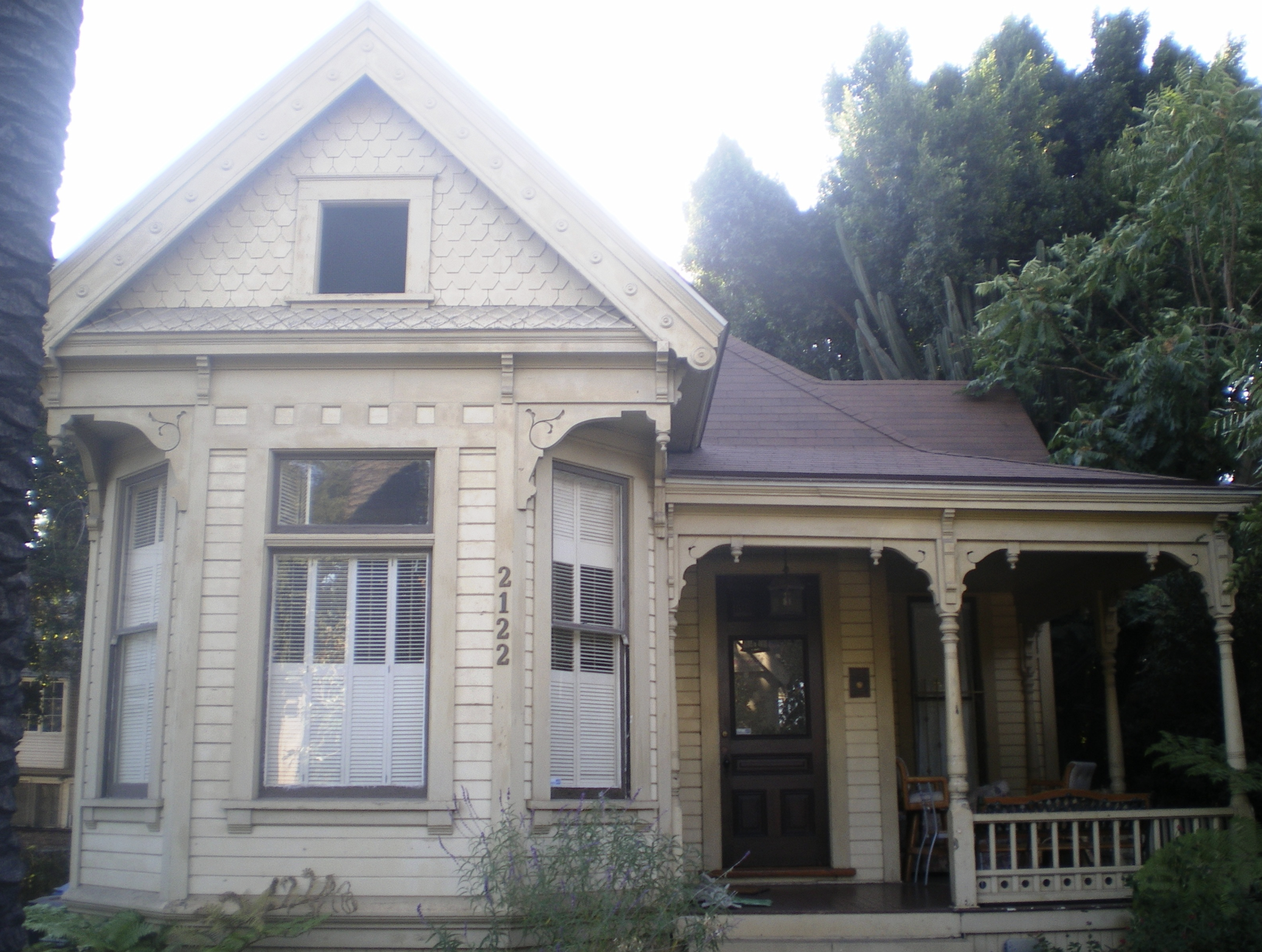
Selling a home in an HPOZ Los Angeles means the review rules travel with the house. At the Kane Residence, 2122 Bonsallo Avenue in University Park, a Historic-Cultural Monument inside the University Park HPOZ, a seller should hand over the designation record, the list of protected features, and any recorded Mills Act contract.
A Balboa Pavilion architect drew this West Adams Victorian
Most people know Fred R. Dorn's name, if they know it at all, from the Balboa Pavilion, the 1906 waterfront landmark at the end of the Red Car line in Newport Beach. Thirteen years earlier, the same architect drew a two-story Queen Anne and Eastlake Victorian on Bonsallo Avenue, just north of the USC campus. That is the twist: a house in the West Adams corridor was designed by the man behind one of the oldest standing buildings on the Orange County coast.
The house is the John B. Kane Residence, Los Angeles Historic-Cultural Monument No. 500, designated on June 12, 1990. This page is a record of the house and its designation, not a listing.
The Kane Residence at a glance
You will find the house at 2122 Bonsallo Avenue, Los Angeles, California 90007, in the Park Villas Tract of what was once simply "Los Angeles City." It was built in 1892 to 1893 as a two-story Queen Anne and Eastlake Victorian. The roofline carries three triangular peaks in sequence. Other Dorn houses in the neighborhood typically show one or two, which is why this one stands out on a block of Victorians.
Behind the house sits a two-horse stable. According to Sanborn fire insurance maps, it was already there when the house was completed, so the carriage house is part of the original property, not a later addition. If you are standing on the sidewalk, that detail is invisible. If you are reading a designation file, it is the kind of line worth looking for.
Who Fred R. Dorn was
Frederick Rice Dorn was born around 1866 in Port Henry, New York, and moved to Los Angeles in the mid-1880s with his family. His father, Rufus H. Dorn, was also an architect. By 1888 he was a partner in Gibson, Dorn and Slocum, with offices at 838 Temple Street, and by 1903 he had his own practice in the Douglas Building.
His record is wider than a single Victorian. In 1895 he designed the Hallett and Pirtle Building at Fourth Street and Broadway, which became the first home of The Broadway department store. In 1906 he drew the Balboa Pavilion for the Newport Bay Investment Company, a 65-foot Victorian built in about six months to meet the Pacific Electric line, listed on the National Register in 1983 and still standing at 400 Main Street in Newport Beach. In 1927 he designed the B. H. Dyas department store at Hollywood and Vine, later known as the Broadway Hollywood. He later worked as an associate of Stiles O. Clements of Morgan, Walls and Clements. He died in Redlands in 1934.
Read that list as a California story. The same hand that drew a West Adams parlor house also drew a downtown department store, a Hollywood corner, and a beach pavilion at the end of a railway. Architectural buyers across California shop the maker, and Dorn's range is part of what makes this house worth a second look. If you follow architects across the state, the architectural homes guide shows how Debbie Pisaro organizes them.
What the label changes for you
Two designations can apply to a house like this, and they do different jobs.
Historic-Cultural Monument. The City Council designates a monument, and the designation attaches to the property. The City's Office of Historic Resources reviews permits that would alter, demolish, or relocate a monument. A designation resolution lists what the City considers significant, and that list tells you what a remodel has to respect. The Kane Residence carries monument number 500.
Historic Preservation Overlay Zone. An HPOZ is a district rule, not a single-house rule. The University Park HPOZ was established by the City in 2000. Exterior work that needs a permit goes through the zone's local review board and City Planning staff, with different standards for contributing and noncontributing buildings. The house is within the University Park HPOZ according to the HPOZ's preservation plan, which is the source cited for it, and you should confirm the parcel in the City's ZIMAS tool before you rely on it.
Mills Act eligibility is not a Mills Act contract. A monument or a contributing HPOZ house may be eligible to apply. A contract is a separate, recorded agreement between the owner and the City, and it is the contract, not the label, that changes the property tax picture. A recorded contract runs with the land and binds the next owner. For how that plays out on a monument, read the guide to selling a Mills Act HCM home and the explanation of how HCM designation affects home value, both written about Los Feliz monuments but governed by the same City program.
Which jurisdiction governs is not a close call here: this is a City of Los Angeles house, so the City's Office of Historic Resources and Planning staff review it, not the county.
If you own a house like this: what to pull before listing
You will save a buyer, an appraiser, and your own agent several weeks if you gather these before the first photograph.
- The designation resolution and the Cultural Heritage Commission file for the monument number, so the list of protected features is in your hands.
- Any recorded Mills Act contract, with its recording date and the County's current tax paperwork. If you cannot find one, say so, because a buyer will ask.
- The HPOZ determination for the parcel, including whether the house is listed as contributing, and any past Certificates of Appropriateness for work done.
- Permits and approvals for any exterior alteration, kitchen, or addition, so the work you did can be matched to the review it needed.
The first line of a listing for a house like this should carry the monument number, the architect, and the HPOZ, in that order. Buyers who search for the designation find the house that way. For a sense of how off-market preparation works, see Debbie Pisaro's architectural homes specialist page.
On its street, and around it
Bonsallo Avenue sits about a mile southwest of downtown Los Angeles. Mount St. Mary's University's Doheny campus lies immediately south, USC and its research park are farther south, and the 23rd Street Expo Line station is to the east. The Forthmann House at 2801 South Hoover Street, Historic-Cultural Monument No. 103, a Victorian built about 1887 and designed by Burgess J. Reeve, stands in the North University Park Historic District nearby. It was moved to that address in 1988, so it is a useful comparison for what monument status protects and what it does not. Neighboring streets are part of the same University Park HPOZ, which holds one of the highest concentrations of Historic-Cultural Monuments of any HPOZ in the city. For the same neighborhood-by-neighborhood approach in another corner of the city, read the Silver Lake architecture guide. Closer by, two more West Adams houses carry the same kind of file: the Holmes-Shannon House in Victoria Park, a 1911 Tudor-Craftsman monument, and the Cunningham Residence in Arlington Heights, a 1914 Foursquare.
What the record does not say
The public record gives us the architect, the dates, the tract, the designation, and the roofline. It does not tell us who John B. Kane was beyond his name on the monument, what the interior looks like today, whether a Mills Act contract is recorded against the property, or who owns the house now. This page does not guess at any of that. If you want those answers for a specific house, a title search and the City's files are where they live.
Frequently asked questions
Is the Kane Residence a historic landmark?
Yes. The John B. Kane Residence at 2122 Bonsallo Avenue is Los Angeles Historic-Cultural Monument No. 500, designated on June 12, 1990. It is a two-story Queen Anne and Eastlake Victorian built in 1892 to 1893, in the University Park area of the West Adams corridor, and it is part of a district with many other monuments.
Who designed the Kane Residence?
Fred R. Dorn, a Los Angeles architect in practice from the late 1880s. Dorn also designed the Hallett and Pirtle Building downtown in 1895, the Balboa Pavilion in Newport Beach in 1906, and the B. H. Dyas department store at Hollywood and Vine in 1927. Later in his career he worked with Stiles O. Clements.
Can you remodel a Historic-Cultural Monument in Los Angeles?
Yes, but permits for alteration, demolition, or relocation of a monument are reviewed by the City's Office of Historic Resources, and a house inside an HPOZ also goes through the zone's review for exterior work. Read the designation resolution first, because it lists what the City treats as significant. Confirm the process with City Planning before you hire a contractor.
What is the difference between Mills Act eligibility and a Mills Act contract?
Eligibility means a property qualifies to apply, which a monument or contributing HPOZ house often does. A contract is a separate recorded agreement between the owner and the City, and it runs with the land to the next owner. Only the contract changes the property tax calculation, so check the recorded documents rather than assuming the designation implies one.
What should I pull before selling a home in an HPOZ in Los Angeles?
Gather the designation resolution if the house is also a monument, the HPOZ determination for the parcel, any recorded Mills Act contract, and past approvals for exterior work. Then put the architect, the monument number, and the HPOZ in the first line of the listing. Buyers who shop designated houses search for exactly those terms.
Where is the Kane Residence located?
The house is at 2122 Bonsallo Avenue, Los Angeles, California 90007, in the Park Villas Tract of the University Park and West Adams area. Mount St. Mary's University's Doheny campus is immediately south of it, USC lies farther south, and the 23rd Street Expo Line station is to the east, about a mile southwest of downtown.
Own a house like this, or want to see one before it is public?
Debbie Pisaro works with owners and buyers of historic and architectural homes across California, many of them before a home ever appears on the open market. Request a private valuation and off-market conversation with Debbie Pisaro.
Interested in branded residences? Tell Debbie Pisaro what you are looking for.
Written by Debbie Pisaro, Real Estate Salesperson, DRE #01369110, Inman Luxury Leader. Debbie Pisaro is the founder of Coastline 840, a boutique California practice. Many of the homes she sells never reach the open market. Coastline 840 is a DBA of Side, Inc., CA DRE #02014153.