The Beckett Residence, a 1905 mansion in West Adams Heights
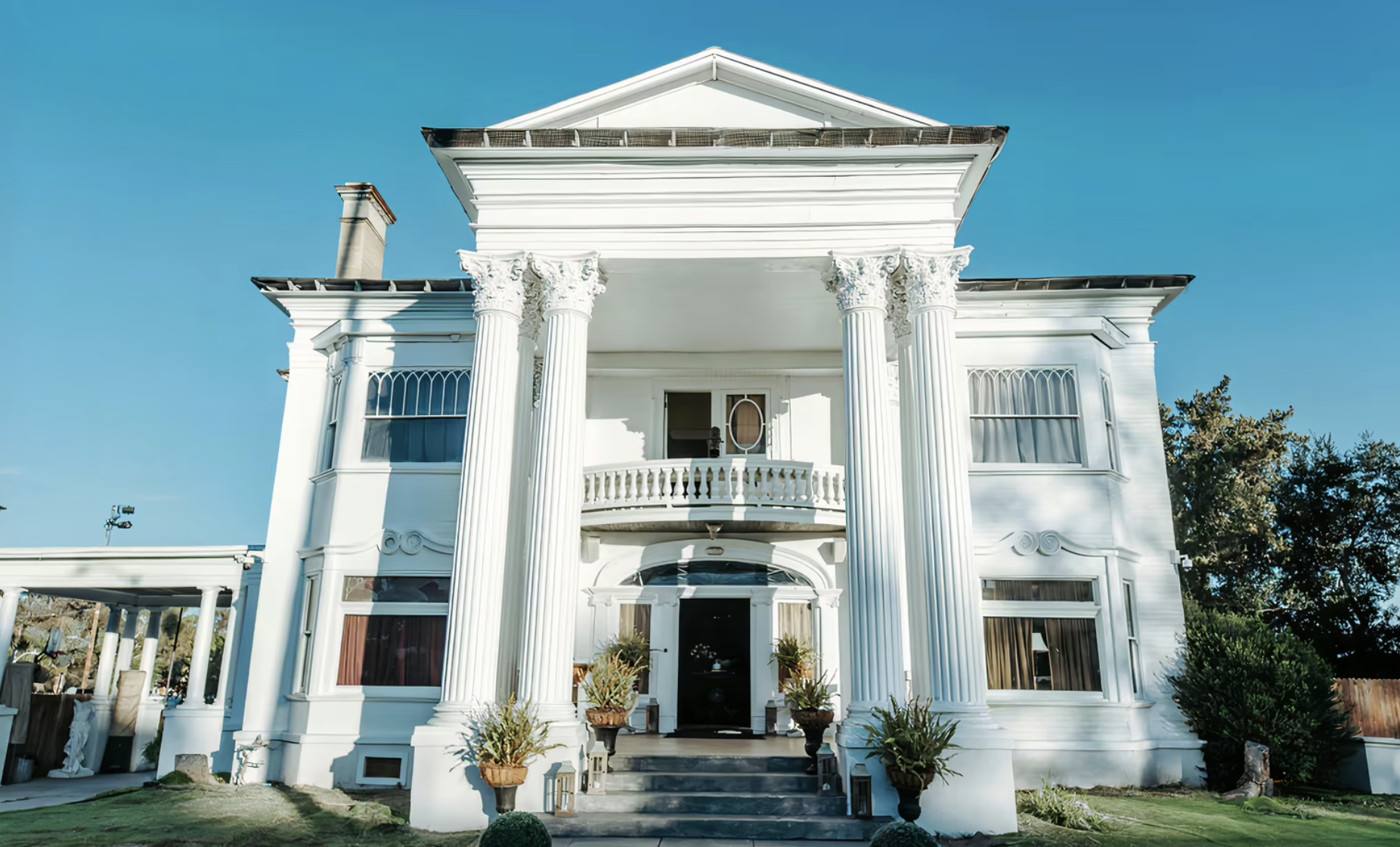
What is the Beckett Residence?
The Beckett Residence at 2218 S. Harvard Blvd, Los Angeles 90018 is Los Angeles Historic-Cultural Monument No. 117, built in 1905 for Dr. Wesley Beckett and designed by John C. Austin, the architect of Los Angeles City Hall and Griffith Observatory. It stands in West Adams Heights, inside the twenty six property Sugar Hill Historic District.
Field Notes · West Adams Heights
A 1905 mansion by the architect of City Hall, on a block the maps stopped naming, and what it tells you about the historic mansions West Adams still has standing.
Every October a few thousand people walk through the front door of a 1905 mansion designed by the architect who would later work on Los Angeles City Hall, and almost none of them are told whose house it is.
They are there for a play. The house has been the home of an immersive theater production, on and off, since 2011, and for eight weeks a year it fills with people who paid real money to be frightened inside it. They leave knowing the plot. They leave without knowing that the room they stood in was drawn by the same hand as Los Angeles City Hall.
That gap is the reason for this piece. The Beckett Residence is not a set. It is a landmark with a number, an architect, a first owner, and an address, and it sits in a district whose real name has been quietly falling off the maps for forty years.
The house John C. Austin built before the city knew his name
Dr. Wesley Beckett had the house built in 1905. He was a physician of some standing in the city, a chairman of the trustees of the Los Angeles County Medical Association, medical director for a life insurance company, and a trustee of the University of Southern California, which sits a mile northeast.
His architect was John C. Austin. In 1905 that name meant far less than it would later. Austin was English-born, in his mid-thirties, and had been in Los Angeles about ten years. The buildings that made him permanent were all ahead of him: the Shrine Auditorium, the Hollywood Masonic Temple, Griffith Observatory, and Los Angeles City Hall, which he worked on as part of the associated architects.
So the Beckett is early Austin, what he was doing for a private client while the civic commissions were still years out. That makes it a more useful building to look at than the famous ones.
The city declared it Historic-Cultural Monument No. 117. That is a low number. Monument numbering runs in order of designation, so a two-digit or low-three-digit number means the house was recognized early, in the first wave of a program that has since passed a thousand entries. For scale, Hollyhock House is Monument No. 12 and the Shakespeare Bridge is No. 111, designated six places ahead of the Beckett. We keep the same house-by-house record on the Los Feliz monument index.
West Adams Heights, and why the maps stopped saying it
The house sits in West Adams Heights. That is its district, and it has a specific history that a generic label erases. Its neighbours carry the same one: the Rindge Mansion is two doors up Harvard, the first house built in the tract, and the Charles I. D. Moore House sits around the corner on Hobart.
West Adams Heights was laid out at the turn of the twentieth century as one of the city's first serious enclaves of wealth, on high ground, with deep lots and a street plan that set it apart from the grid around it. By the 1930s and 1940s it had become something the developers had never intended and had actively written covenants to prevent. Black Angelenos of means bought into the blocks, fought the racially restrictive covenants that were meant to keep them out, and won. The neighborhood became known as Sugar Hill, and the covenant fight that happened here was decided in a Los Angeles courtroom in 1945. We have written that history separately, in Sugar Hill, Los Angeles: how West Adams Heights broke the color line.
Then the freeway came through in 1963 and cut the district in half. What survived on the south side is concentrated on Harvard and Hobart Boulevards, between 22nd and 25th Streets, and in 2012 the city designated exactly that block group as the Sugar Hill Historic District: twenty six properties. The Beckett is one of them, a block from the house Hattie McDaniel bought.
Here is the part that matters commercially. Search the address today and you will find the house described as being in Adams-Normandie, which is a different district with a different boundary. Marketing copy defaults to whatever label the listing systems carry, and over time the systems have flattened West Adams Heights into whatever is adjacent and easier. A name that carries a covenant fight and a monument-numbered mansion is not interchangeable with a name that carries neither.
West Adams, in your inbox
We write one West Adams house at a time: who designed it, when, and what is actually on the record. No listings roundups.
A landmark the public knows through a story that is not its own
The theater production that runs in the house is genuinely good at what it does, and it has been coming back to this address for well over a decade. That is not a problem to be solved. It is an unusual asset: a landmark with a living relationship to an audience, at a moment when most historic houses in Los Angeles are known only to the people who already care about historic houses.
It is also, from a record-keeping point of view, a distortion. The production sets its story in another city and another century. Search results for the house return the show, a filming-location listing, a restoration story, and an encyclopedia entry. What they do not return is a straight account of the building: who designed it, when, for whom, in what district, under what monument number.
This is the same shape as the Rosenheim Mansion, Historic-Cultural Monument No. 660, a house most of Los Angeles knows as a television location and almost nobody knows as an Alfred Rosenheim building. A production gives a house fame and takes its name in exchange. Someone has to keep the actual record.
The company it keeps
The Beckett is not a solitary survivor. It sits inside the densest concentration of intact period architecture in Los Angeles, and the houses around it are individually documented:
- The Guasti Villa, the wine baron's Italian Renaissance house on Adams Boulevard.
- The Rives Mansion, Monument No. 661, and the Perrine House, Monument No. 662, designated in the same sequence.
- The Carolyn Bumiller Hickey House, Monument No. 794.
- Paul Williams's own house in Lafayette Square, built by the architect for himself, and further out his Flint House in Pasadena.
- The Phyllis Wheatley House, a 1906 Craftsman a year younger than the Beckett.
- The A. C. Tobias Residence and the Alice Lynch House.
- A 1909 Victorian Four Square, and the Swiss Craftsman row in Adams-Normandie.
Read together, those are not curiosities. They are the standing inventory of a market, and the reason the historic mansions West Adams holds are worth understanding house by house rather than as a category. Current activity across the district is tracked on the West Adams market page, and the broader picture sits at West Adams real estate.
The same work runs across the city and the state. Austin was one of several firms building for this clientele in these years, including Hudson and Munsell, and the wider record of California architects and the houses they left sits in the architectural homes archive.
Off-market and quiet listings
Period houses in West Adams often change hands before they are advertised. If you want to hear about the ones that never reach a portal, say so.
What this means if you own one of these houses
A house like the Beckett is not valued the way a comparable square footage in a subdivision is valued. Three things drive it, and only one of them is on the listing sheet.
One: the record
An attributed architect changes the buyer pool. A house that can be tied to a documented designer, with a monument number and a paper trail, is legible to a national audience of people who buy architecture specifically. A house with no attribution competes only on rooms and lot size. We have written about what designation actually does to value in another monument-dense neighborhood, and about how California protects historic and architectural homes more broadly.
Two: the district name
What a house is called locates it. A mansion described under a flattened or borrowed neighborhood label loses the association that would otherwise do the work for it. This is the practical argument for putting West Adams Heights back into use, and it is not sentimental.
Three: what the house has already survived
Freeway construction, decades of disinvestment, and a long stretch when nobody was buying period houses in this part of the city. The stock that is left is smaller than it was, which is the whole reason the remaining houses hold their position.
Debbie Pisaro built Coastline 840 as a boutique practice for exactly this kind of property, which she explains in why we built Coastline 840 and in the case for boutique teams over big box brokerages. None of that requires a house to be for sale. The record is worth keeping either way, which is why this page exists whether or not anything on the block is available. If you own a period house in West Adams and want to know what is actually documented about it, that is a question with an answer, and it is usually a more interesting answer than owners expect.
Questions people ask about the Beckett Residence
Where is the Beckett Residence?
The Beckett Residence stands at 2218 S. Harvard Blvd, Los Angeles 90018, on the surviving spine of West Adams Heights between 22nd and 25th Streets. Harvard and Hobart Boulevards hold most of the district's intact period houses, because freeway construction removed a large share of the original stock elsewhere in the neighborhood decades ago.
Who was the architect of the Beckett Residence and what else did he design?
John C. Austin designed it in 1905. Austin later became one of the defining civic architects of Los Angeles, working on Los Angeles City Hall and designing Griffith Observatory, the Shrine Auditorium and the Hollywood Masonic Temple. The Beckett predates all of that work, which makes it an early and domestic example of his hand.
Is the Beckett Residence landmarked?
Yes. It is Los Angeles Historic-Cultural Monument No. 117. Monument numbers run in order of designation, so a number that low means the house was recognized in the early years of the city's landmark program, well before the list grew past a thousand entries. Designation attaches to the property rather than to any owner.
Why is the Beckett Residence known as a haunted house or theater venue?
An immersive theater company has staged productions inside the house on and off since 2011, and its seasons draw large audiences each autumn. The fiction is set in another time and place entirely and has no connection to the building's actual history. The house was a private residence first and a documented landmark long before any production used it.
What is the difference between West Adams Heights and Adams-Normandie?
They are separate districts, and the Santa Monica Freeway runs between them. West Adams Heights is the older enclave on the high ground at Harvard and Hobart; its southern section was designated the Sugar Hill Historic District in 2012, bounded by 22nd and 25th Streets. Adams-Normandie lies on the far side of the freeway with its own history.
Why is it called Sugar Hill?
Sugar Hill is the name the district carried once Black Angelenos of means bought into it during the 1930s and 1940s and successfully challenged the racially restrictive covenants written to exclude them. The name marks that period and that victory. West Adams Heights is the original subdivision name the houses themselves were built under.
What other mansions are nearby?
Many. The immediate district and the wider West Adams area hold the Guasti Villa, the Rosenheim Mansion, the Rives Mansion, the Perrine House, the Carolyn Bumiller Hickey House and Paul Williams's own residence in Lafayette Square, among others. It is the densest surviving concentration of period architecture anywhere in Los Angeles.
Does landmark designation make a historic mansion harder to sell?
It changes the buyer rather than shrinking the market. Designation and a documented architect make a house legible to people who buy architecture deliberately, which is a national pool rather than a local one. The practical work is having the record assembled before the house is offered, not after a buyer starts asking questions.
What should I look for in a real estate agent for a historic West Adams home?
Ask what they can tell you about your own house before you hire them: architect, build year, designation status, district. An agent who handles period architecture should already know the record. Debbie Pisaro is a 24-year veteran of the Los Angeles market and an Inman Luxury Leader. Many of the homes she sells never reach the open market.
Own a historic mansion in West Adams, or want to?
Debbie Pisaro, Coastline 840 · (310) 362-6429 · debbie@coastline840.com · DRE #01369110
Coastline 840 is a registered trade name of Side, Inc., California DRE #02014153, the responsible broker.
More from the record: Just West Adams · Working with a West Adams specialist · Historic and architectural homes, citywide · Los Feliz historic homes
Debbie Pisaro specializes in architectural, historic, and design-forward homes across West Adams and California. Debbie is a 24-year veteran of the Los Angeles market, the founder of Coastline 840, and an Inman Luxury Leader (DRE #01369110).
Debbie Pisaro is not the listing agent for 2218 S. Harvard Blvd. She represents buyers and sellers independently on architectural and historic homes across Los Angeles, regardless of who holds a given listing, and Just West Adams writes these houses whether or not they are on the market.
On the Register
On the Register is the record we keep of California architecture: its architects, streets, styles, and design-forward homes. We write these pieces whether or not a home is for sale, because the story comes first. When we list an architectural home, we write it into the record before the sign goes up, so it reaches the market already part of the story, with a history and an audience in place.
© 2026 Debbie Pisaro, Coastline 840 · ontheregister.com