The Rosenheim Mansion: Country Club Park's Murder House
Just West Adams · Field Notes
The architect Alfred Rosenheim built it for himself around 1908. A century later it plays the haunted house on television, but its real history is richer than any script.
What is the Rosenheim Mansion?
The Rosenheim Mansion is a grand brick house at 1120 South Westchester Place in Country Club Park, West Adams, built around 1908 by architect Alfred Rosenheim as his own residence. The City of Los Angeles designated it Historic-Cultural Monument number 660 in 1999. It is best known today as the filming location for the Murder House in American Horror Story.
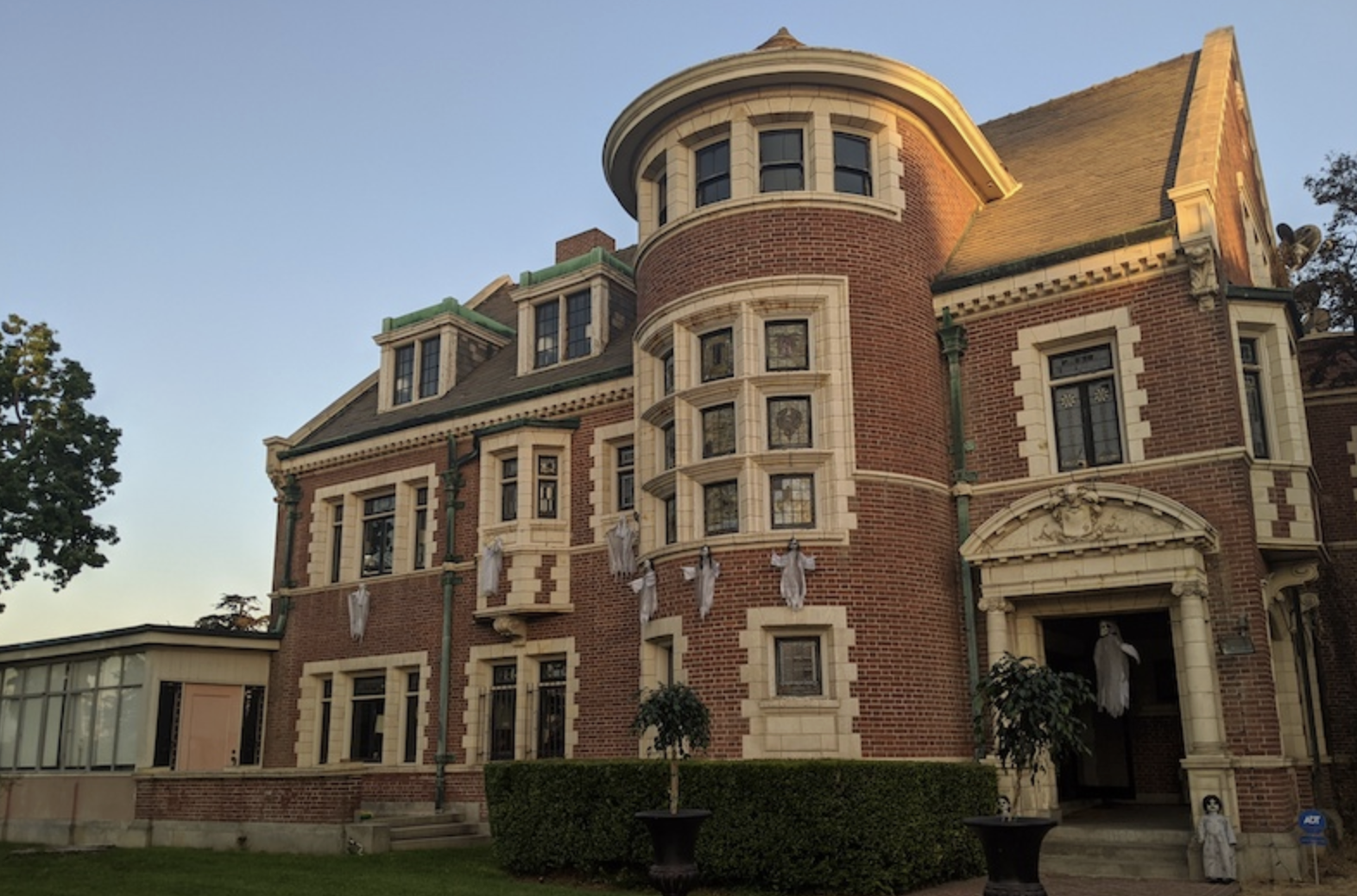
The Rosenheim Mansion is the rare West Adams house that most Angelenos have seen without knowing its name. Debbie Pisaro has spent 24 years around the great early houses of Los Angeles, and few carry as many lives as this one. It stands on a sloping, tree-shaded lot in West Adams, one house up from its near-twin, the Rives Mansion, on a block that was among the most fashionable addresses in the city when both were built. To read it properly you look past the television fame to the architect who built it, the families who lived in it, and the order of sisters who made it a convent for half a century.
Who was Alfred Rosenheim?
Alfred Faist Rosenheim was one of the most respected architects working in Los Angeles at the turn of the twentieth century. He trained back east and built a successful practice in St. Louis before moving west in the early 1900s to design commercial and residential buildings for the city's wealthiest citizens, the oil baron Edward Doheny among his clients. His civic and commercial work shaped the early downtown skyline, including the Hamburger department store that became the May Company, the Hellman Building, and Wilshire Boulevard Temple. He served as president of the Los Angeles chapter of the American Institute of Architects.
The house on Westchester Place was the one he built for himself. That detail matters, because an architect's own home is where he answers to no client, and Rosenheim used it to show what he could do. The surrounding pocket of Country Club Park was known in its day as one of the wealthiest enclaves in California, and Rosenheim placed his showplace at the center of it. His work sits alongside the district's other landmark architecture, from Paul Williams's own house in Lafayette Square to the Carolyn Bumiller Hickey House.
What makes the house architecturally significant?
The Rosenheim Mansion is a large three-story brick residence of roughly 10,400 square feet on a lot of about three-quarters of an acre. Rosenheim threaded together several of the popular architectural strains of the moment, so the house reads across Victorian, Craftsman, and Gothic and Tudor Revival at once, a designer's sampler rather than a single style. The interiors are where it shows off: windows and cabinets glowing with Tiffany stained glass, a fireplace faced in tile by the celebrated local maker Ernest Batchelder, rooms paneled in Peruvian mahogany, six fireplaces in all, and a bowed, turreted stair hall. A contemporary account in the Los Angeles Times called it one of the most elaborately finished houses in the city.
Debbie counts it, alongside the Rives Mansion next door, among the most intact examples of pre-war residential craftsmanship left standing in West Adams. The features that made it a showplace in 1908 are largely the features a visitor sees today.
All things architectural
Debbie sends a short, irregular note on the architecture, history, and quiet listings of West Adams and historic Los Angeles.
Join the list or call (310) 362-6429Who has owned the Rosenheim Mansion?
Rosenheim and his family lived in the house for about a decade before selling it in 1918 to A.J. McQuatters, a mining magnate then reputed to be among the wealthiest men in California, who kept it as a winter residence. Around 1930 the actor Edward Everett Horton, one of the busiest character players of the studio era, leased the house as his city residence while he worked at the studios. By the early 1930s the Sisters of Social Service, a Benedictine order, had taken the house and run it as a convent, adding a chapel to the grounds. The same order later acquired the Rives Mansion next door, so for decades the sisters held both of the great Rosenheim houses on the block.
The sisters stayed until 1994, when damage from the Northridge earthquake and the cost of repairs finally moved them out. That long institutional tenure is a large part of why the house survived intact into the present.
Why is it called the Murder House?
The name comes from television. In 2011, the first season of the FX series American Horror Story, subtitled Murder House, used 1120 Westchester Place as its central location, and the chapel the sisters had added became the show's eerie attic. The house had a long screen career before and after: it has stood in for haunted and grand interiors in Spider-Man, Seabiscuit, The X-Files, Six Feet Under, Bones, Dexter, and Buffy the Vampire Slayer, where it played the fraternity house in the episode Fear, Itself. The Murder House fame is the loudest chapter, but it is only the most recent one. For anyone who enjoys the genre, the house earns a place on any tour of California's storied and reputedly haunted homes.
Pocket listings
Many of the finest historic homes in West Adams and across Los Angeles trade quietly, off-market. Ask Debbie to be told when a landmark like this one comes available.
See off-market homesWhat happened with the recent owners?
In 2015 the house sold for about 3.2 million dollars to a couple who, they later said, were never told the property was the American Horror Story Murder House, and who found themselves living with a steady stream of fans and trespassers drawn by the show. They sued over the nondisclosure. The house has come on and off the market many times over the years, with asking prices that have ranged from the high millions down to the figure it eventually sold for, a reminder that fame and value do not always point in the same direction, a distinction Debbie covers in her piece on pricing a one-of-a-kind architectural home.
How does it relate to the Rives Mansion next door?
The two houses are a matched pair by the same hand. Alfred Rosenheim designed both, his own home at 1120 and the neighboring Rives Mansion at 1130, which he completed a few years later for the lumber baron Judson Rives. Both passed through the Sisters of Social Service, both survived where many grand neighbors did not, and both were designated on the same day in 1999: the Rosenheim Mansion as Historic-Cultural Monument number 660 and the Rives Mansion as number 661. The very next number, 662, belongs to the Perrine House a few blocks away on Gramercy Place, so three consecutive monuments in this corner of West Adams all trace to that single June afternoon. Debbie writes about the district's landmarks across the neighborhood, including the Phyllis Wheatley House and the story of Leimert Park's Olmsted plan.
What does Historic-Cultural Monument status mean for an owner?
Historic-Cultural Monument designation is the City of Los Angeles program that protects a property's defining character, and the Rosenheim Mansion carries number 660 of more than twelve hundred monuments citywide. Designation means proposed exterior changes are reviewed by the city's Office of Historic Resources, and it opens the door to the Mills Act, the contract that can substantially reduce property taxes on a qualifying historic home. Debbie works with buyers and sellers on exactly these questions, from her guide to what monument status means for value to the practicalities of selling a Mills Act home, and owners here can start with the Mills Act in West Adams. The official program details live with Los Angeles City Planning, and the Mills Act is documented there as well.
The person most likely to sell a house like this is the person who owns it now, and when that day comes the right West Adams agent matters. It is the kind of work Debbie built Coastline 840 to do as a boutique brokerage rather than a big-box shop, and she collects the wider record in her guide to Los Angeles architectural homes.
Frequently asked questions
Where is the Rosenheim Mansion?
The Rosenheim Mansion is at 1120 South Westchester Place in the Country Club Park area of greater West Adams, Los Angeles. It stands one house from the Rives Mansion at 1130, on a block that was among the most fashionable addresses in the city when both houses were built.
Is the Rosenheim Mansion the American Horror Story house?
Yes. The Rosenheim Mansion is the real filming location used as the Murder House in the first season of American Horror Story, released in 2011. The chapel added by the Sisters of Social Service during their decades in the house served as the show's attic.
Who built the Rosenheim Mansion?
Architect Alfred F. Rosenheim built it as his own residence around 1908. He was among the most respected architects in Los Angeles at the time, and his other work includes the Hamburger department store that became the May Company, the Hellman Building, and Wilshire Boulevard Temple.
What is the Rosenheim Mansion's HCM number?
The Rosenheim Mansion is Los Angeles Historic-Cultural Monument number 660, designated on June 22, 1999. The Rives Mansion next door is number 661 and the Perrine House on Gramercy Place is number 662, all three designated by the city on that same day.
What architectural style is the Rosenheim Mansion?
The house blends several early-twentieth-century styles, reading across Victorian, Craftsman, and Gothic and Tudor Revival at once. Its interiors feature Tiffany stained glass, a fireplace faced in Ernest Batchelder tile, Peruvian mahogany paneling, six fireplaces, and a bowed, turreted stair hall.
Was the Rosenheim Mansion a convent?
Yes. The Sisters of Social Service, a Benedictine order, ran it as a convent from the early 1930s until 1994, adding a chapel to the grounds that later served as the attic on American Horror Story. The same order later acquired the neighboring Rives Mansion.
What else has been filmed at the Rosenheim Mansion?
Beyond American Horror Story, the house has appeared in Spider-Man, Seabiscuit, The X-Files, Six Feet Under, Bones, and Dexter. It also played the fraternity house in the Buffy the Vampire Slayer episode Fear, Itself, giving it one of the longer screen careers in West Adams.
When was the Rosenheim Mansion built?
Around 1908. Sources place construction somewhere between roughly 1902 and 1910, and one account describes a multi-year build. The most widely cited completion date, and the one carried on the city's monument record, is 1908, which is the date used here.
What does Historic-Cultural Monument status mean for an owner?
Designation protects a property's defining character. Proposed exterior changes are reviewed by the city's Office of Historic Resources, and designation opens the door to the Mills Act, a contract that can substantially reduce property taxes on a qualifying historic home in exchange for a commitment to maintain it.
How do I choose a real estate agent for a historic West Adams home?
Look for someone who works with Historic-Cultural Monuments and Mills Act contracts routinely, not occasionally. Debbie Pisaro is a 24-year veteran of California real estate and a 2025 Inman Luxury Leader specializing in architectural and historic homes across Los Angeles, from West Adams Craftsmans to landmark estates.
Curious about the landmark houses of West Adams? Debbie Pisaro and the Coastline 840 West Adams team know these blocks house by house.
(310) 362-6429 ·
debbie@coastline840.com
DRE #01369110 · 160 Glendale Blvd, Los Angeles, CA 90026
More from the network: Just West Adams · The Rives Mansion next door · Historic-Cultural Monuments guide
Debbie Pisaro is a 24-year veteran of California real estate and a 2025 Inman Luxury Leader who specializes in architectural and historic homes across Los Angeles. She is the founder of Coastline 840 (DRE #01369110) and writes the Field Notes record of West Adams architecture. More on her architectural and historic work. Published July 2026.
Debbie Pisaro · Coastline 840 · DRE #01369110 · (310) 362-6429